Marina Cap Cana: what the record says, and what it means at Makai
Marina Cap Cana is Cap Cana's harbour and, in the words of the Ministry of Environment's 2024 plan for the marine sanctuary around it, the main tourist port facility in this part of the country; from Makai Residences it is about 4.4 miles by road, around 11 minutes. This page reads the marina through that plan and through the marina's own figures: how big and how busy it is, which months fill it, what the sanctuary asks of anyone on a boat, how storms have treated this coast, and what all of it adds to owning at Makai.
What is Marina Cap Cana, and how far is it from Makai?
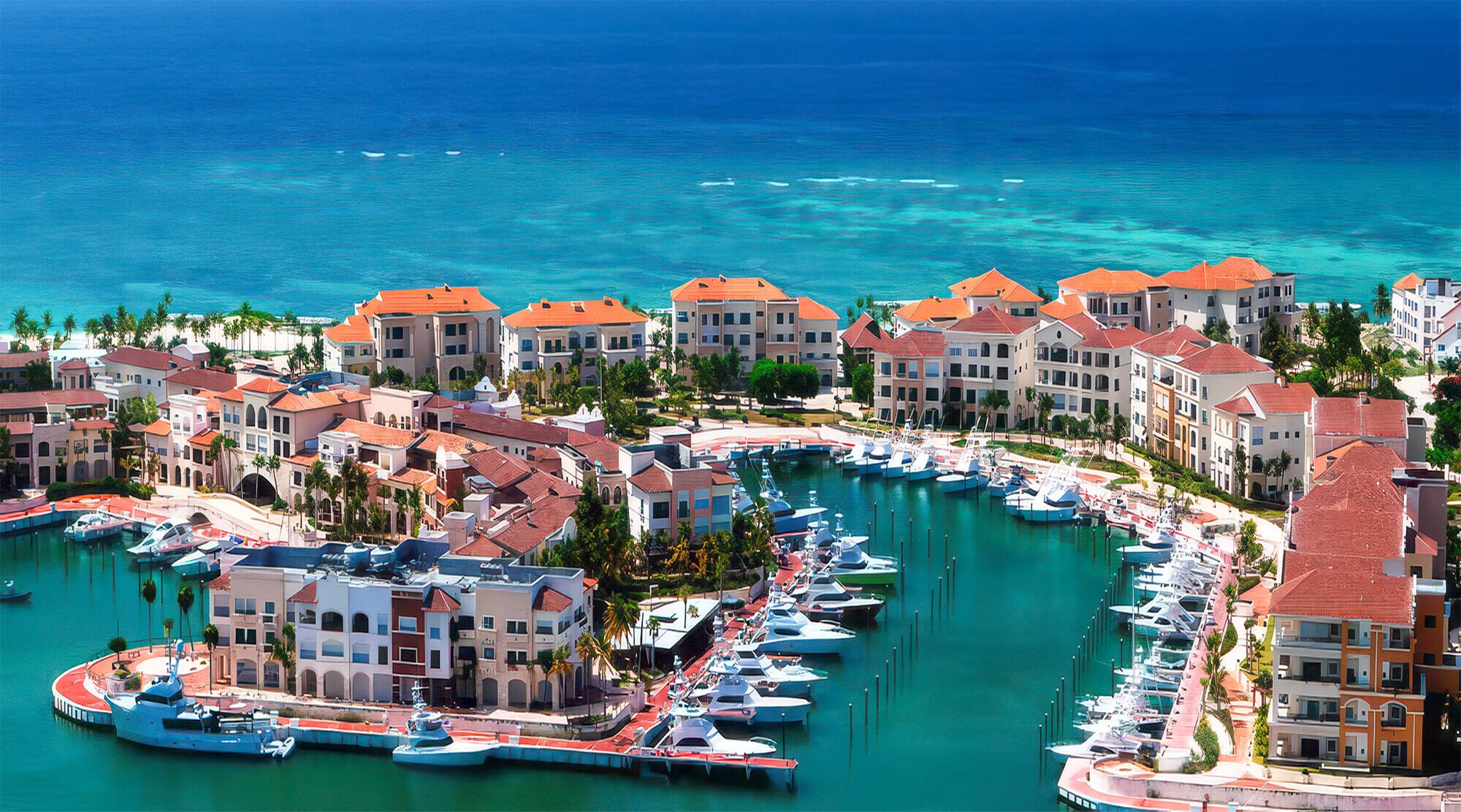
Marina Cap Cana is the harbour of Cap Cana, the gated community where Makai is being built. The Ministry of Environment's 2024 management plan for the Southeast Reefs Marine Sanctuary, the protected sea along this coast, describes it as the main tourist port facility in this part of the country. Of the sanctuary's three sport and tourist marinas, the plan dates Punta Cana's to the 1970s and Cap Cana's and Casa de Campo's to the 2000s, and it notes that the Cap Cana and Punta Cana marinas adjoin each other on the same shore, Cap Cana's reaching toward Punta Bobadilla to the south-west and Punta Cana's toward Punta Yauya to the north-east. The marina's own website lists more than 150 slips for yachts of up to 250 feet, a fuel dock, customs and immigration on site and an approach channel whose controlling depth it gives as 11.5 feet.
From Makai the trip is a short drive that never leaves the gates. Measured on a public routing engine from Makai's published location, the road to the marina runs about 4.4 miles, by Boulevard Juanillo, Boulevard Central and Avenida Marina, around 11 minutes without traffic. Makai stands beside a lake and the Las Iguanas golf course rather than on the harbour, so for anyone who loves boats the marina is a place you drive to, not the view from the terrace.
When is the marina at its busiest?
The sanctuary plan gives the clearest public picture of how the marina is used. Its director estimated peak traffic at up to 60 boats a day, from 45 to 80 feet long, with the busiest months running from August to December, in step with the sport-fishing calendar. That calendar is the marina's own, and the plan notes that anglers across the south-east of the country commonly plan by it. Sport fishing itself has no official statistics at national level, the plan says, and CODOPESCA, the fisheries council, does not systematically monitor it; what is known is that it goes on all year, in outings of 3 to 6 hours, after wahoo, dorado, barracuda, blue and white marlin, yellowfin tuna and sailfish.
Tournaments are where the crowds show. At the marina's two marlin tournaments of 2022, the plan records more than 136 anglers on 34 boats for white marlin and about 80 anglers on 25 boats for blue marlin. Larger ships keep their distance: an anchorage offshore is held under a concession from the Dominican Port Authority, and the plan's port figures for 2018 to 2022 record 45 arrivals there in five years, 16 tourist vessels and 29 cargo ships, a mix the plan puts down, probably, to a destination still in development. For a quiet day on the water, the pattern points to the first half of the year, with the tournament dates checked before you book.
What does the marine sanctuary ask of anyone on a boat?
Beyond the channel, the water is protected. Cap Cana's coast lies inside the Southeast Reefs Marine Sanctuary, declared in 2009 by Decree 571-09 and covering about 3,000 square miles of sea, and its 2024 plan sets out how boats should treat the coral in three tiers. Across most of the reef, recreational boating runs under speed controls and the sanctuary's other guidelines, cruise ships are expected to drop no anchor on coral, and a site used for diving is not to be fished. A second tier admits only coral nurseries, research and small, controlled educational visits. The strictest tier, which includes Cap Cana's elkhorn coral conservation areas, is marked and open only to conservation and research.
For anglers, the plan adds a point that the photographs on any dock make easy to forget. Catch and release still kills some of the fish it returns, and the toll falls when anglers keep to the rules, above all by never lifting a billfish out of the water, not even for a photograph, and by releasing it in the water once it is under control. The plan also notes that for more than 40 years billfish fishing here has overlapped in time and place with spawning, although Dominican fisheries law, Law 307-04 in its Article 42, prohibits fishing in spawning areas. None of this stops a day out; it shapes how the day is run.
What happens at the marina when a storm comes?
This coast faces the weather. Citing historical storm tracks from NOAA, the sanctuary plan counts at least 32 extreme weather events that crossed some part of the sanctuary between 1851 and 2023, and it names the east coast, from Yuma to Bávaro, where Cap Cana and Punta Cana stand, as its most exposed stretch, with about fifteen direct landfalls, nine of them hurricanes. For the last decade it lists Tropical Storm Gabrielle coming ashore through Cap Cana in 2013 and Hurricane Fiona, at category 2, through Punta Cana in 2022. The Atlantic hurricane season runs from June 1 to November 30.
The marina's answer is where it sits: inland, behind its channel, rather than on the open shore, and the operator describes the result as a protected basin without surge and a refuge in hurricane season. Read that as the operator's description, not a promise; what happens to a particular boat in a particular storm depends on the marina's own procedures, on whether the boat stays in the water or goes into dry storage, and on the owner's insurer. Smaller boats are stopped by weather well short of a hurricane, too. On 15 March 2026, acting on a warning of rising swell and strong winds, the emergency operations centre ordered small, medium and fragile vessels to stay in port along the Caribbean coast from Saona Island to Cabo Engaño, a stretch that takes in Cap Cana. A boat day fixed to one date is a hope rather than a plan, so keep a spare day.
What does the marina add to owning at Makai?
Makai Residences is 216 furnished residences beside a lake in Cap Cana, from $329,000, with handover planned in two phases, in Q2 2028 and Q2 2029, four pools and a private lake dock with kayaks and paddle boards. The water at home is flat and quiet, Playa Caracol is about a 1,600 ft walk away, and the marina, 4.4 miles off, is where engines and the open sea begin. For most owners that is a sensible division: paddle on the lake in the morning, and save the boat days for a calm forecast.
For an owner who wants a boat of their own, the marina is close enough to make it practical, but a berth is not part of the purchase. Makai's published amenities include no marina slip, so a berth, its cost and its availability are a separate arrangement with the marina on its terms, and the storm plan, the insurance and the boat's papers come with it. For an owner who lets the residence, the marina gives guests a half-day worth the drive, and the sanctuary's rules a short paragraph worth leaving in the welcome notes: no anchoring on coral, no billfish lifted out of the water for a photograph, and a spare day for the weather.
Common questions
- How far is Marina Cap Cana from Makai?
- About 4.4 miles by road, around 11 minutes, measured from Makai's published location by Boulevard Juanillo, Boulevard Central and Avenida Marina. Both are inside Cap Cana's gates, so the drive never leaves the community.
- When is Marina Cap Cana busiest?
- From August to December, according to the marina director's estimate reported in the Ministry of Environment's 2024 sanctuary plan: up to 60 boats a day at peak, 45 to 80 feet long, in step with the sport-fishing calendar.
- How many slips does Marina Cap Cana have?
- The marina's website lists more than 150 slips for yachts of up to 250 feet, with a fuel dock and customs and immigration on site. A slip is arranged with the marina itself, so confirm availability for your boat's length and draft.
- Can boats anchor on the reef off Cap Cana?
- The sanctuary's 2024 plan calls for no anchoring on coral reefs and for speed controls on recreational boats, and it sets aside marked elkhorn coral conservation areas in Cap Cana for conservation and research only.
- Does Marina Cap Cana protect boats in a hurricane?
- The marina describes its inland basin as protected and free of surge, but that is the operator's description, not a guarantee. This coast's record includes Tropical Storm Gabrielle through Cap Cana in 2013 and Hurricane Fiona through Punta Cana in 2022, so plan with the marina's storm procedures and your insurer.
Want the details for your own situation?
Ask about availability, layouts or the buying process, and someone from the sales team will get back to you.
Get in touch