Sargassum in Punta Cana: where the seaweed comes from, how to read the outlook, and what it means at Makai
Sargassum in Punta Cana is not a local plant and not a fixed season. It is floating seaweed carried across the Atlantic, arriving in some years from winter and in others hardly at all, and nobody can tell you which beach it will reach next week. What a buyer or guest at Makai, in Cap Cana, can do is understand where it comes from, read the regional outlook that scientists publish each month, and know which months have historically carried the risk. This page walks through those three things and then how the seaweed fits life at Makai.
Where does Punta Cana's sargassum come from?
From the open Atlantic, and only for about fifteen years in its present form. The US Environmental Protection Agency's page on what it calls the Great Atlantic Sargassum Belt says that in the summer of 2011 a new, large aggregation of the seaweed formed in the tropical Atlantic, and unprecedented amounts of it washed onto many islands of the eastern Caribbean. Similar aggregations have formed in the same area in most years since.
That history explains why the subject feels new to anyone who knew this coast before then, and why it is a question of currents and ocean conditions rather than of anything happening on the beach itself. The seaweed floats freely offshore and drifts west with the season; what arrives at a given stretch of sand depends on wind and current in the days before, which is why no source can promise a clean or a weedy week in advance.
How do you check the seaweed outlook before a trip?
Read the regional bulletin, and read it for what it is. The University of South Florida publishes a monthly Sargassum outlook from satellite data, dated at the end of each month, and the Caribbean ocean-observing system CARICOOS republishes it. Its own wording is the first thing to take in: it gives a general outlook of current bloom conditions and future bloom probability for the Caribbean Sea, and it must not be used to predict conditions for a specific location or beach.
The bulletin dated 30 September 2026 is a fair example. Consistent with all previous years, it found the total amount declining in every region during September, though everywhere except the east Atlantic it still sat above the 75th percentile of historical levels. Its outlook was that amounts in all regions would keep decreasing until possibly November, with beaching events continuing but less severe than in summer. For someone planning an autumn or early-winter stay at Makai, that is useful context; for a particular morning at a particular beach, it says nothing, and it says so itself.
Which months carry the most risk?
Patterns help more than forecasts here. A long-running Punta Cana travel resource, revised in January 2026, says the seaweed season has no set start: it can begin as early as January or only in April or May. Over the years it has tracked, October to December carried the least, with seaweed in those months in only 4 to 5 of the last 14 years, while June to August carried the highest concentrations, present in 13 and 14 of the last 15 years. It calls 2025 exceptional, with massive quantities from the end of May that did not ease significantly until August.
The amounts themselves have swung widely. Citing the same university laboratory, a Santo Domingo business magazine reported roughly 10 million US tons of sargassum in the region from January to the end of June 2026, against about 9.1 million in the same months of 2025 and about 1.3 million in 2024. So a quiet year is no promise of the next one, and the calendar below is a tendency, not a timetable.
| Months | What the record shows | Source |
|---|---|---|
| October to December | The least seaweed: present in only 4 to 5 of the last 14 years | Punta Cana travel resource, revised January 2026 |
| January to May | No set start: the season can begin in January, or only in April or May | Same resource |
| June to August | The highest concentrations: present in 13 and 14 of the last 15 years | Same resource |
| January to June 2026 | Roughly 10 million US tons in the region, against about 9.1 million in 2025 | University satellite data, as reported in Santo Domingo |
Is seaweed on the beach a health concern?
Mostly a nuisance, with one real caution. The Florida Department of Health, which deals with the same Atlantic seaweed, says that as washed-up sargassum decomposes it releases hydrogen sulfide, a gas that smells of rotten eggs and can irritate the eyes, nose and throat, and that people with asthma or other breathing conditions may be more sensitive. The seaweed itself does not sting, though tiny organisms living in it can irritate skin.
Its advice is practical: avoid touching or swimming near the seaweed, wear gloves if you must handle it, keep an eye on children, and never cook with it, because it may carry heavy metals. On a heavy day the sensible response is simply to swim somewhere else.
How does a seaweed week play out at Makai?
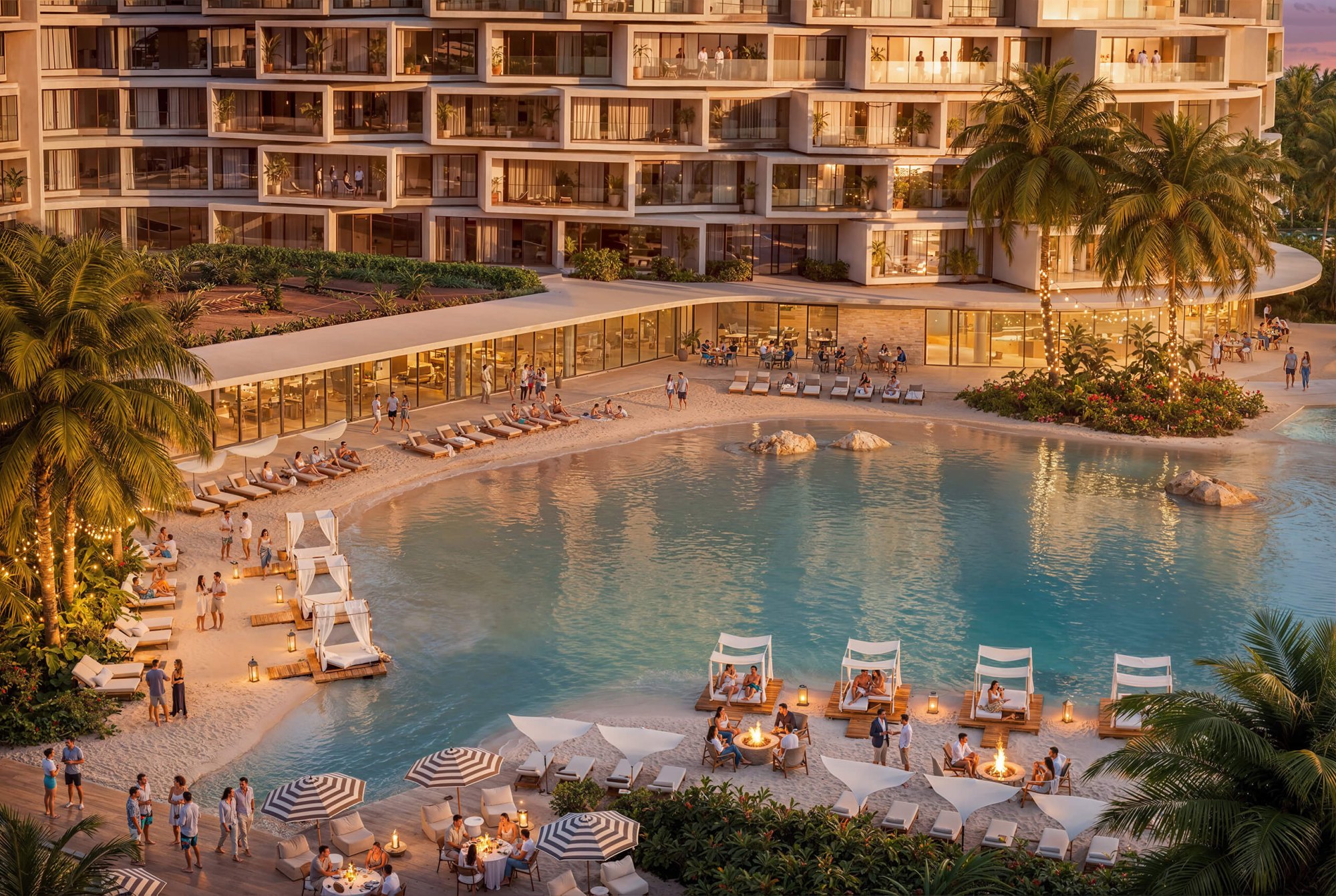
Makai is a development of 216 residences in Cap Cana with 4 pools, among them a walk-in sand pool with a swim-up bar and a rooftop infinity pool, and its delivery is planned in two phases, in 2028 and 2029. The nearest beach, Playa Caracol, is about 1,600 ft away on foot and about 5 minutes by car, and Marina Cap Cana about 4.4 miles by road. On a morning when the sand is clean, the beach is a short walk; when it is not, the pools are on the property and need no outlook at all.
Accounts of the coast nearby disagree, which is worth knowing rather than smoothing over. A long-running Punta Cana travel guide says that when sargassum reaches this coast, Juanillo is usually hit hard and seaweed may pile up on the shore, though the water usually stays clear; a Punta Cana hotel's travel blog says the offshore reef shields Cap Cana's beaches, Juanillo in particular. Treat both as reasons to look for yourself on the day, and to keep the pool in the plan.
Common questions
- When did sargassum start reaching Punta Cana?
- The Atlantic belt in its present form dates from the summer of 2011, when a new, large aggregation formed in the tropical Atlantic and unprecedented amounts washed onto eastern Caribbean islands, according to the US Environmental Protection Agency. Similar aggregations have formed in most years since.
- Is there a sargassum forecast for Punta Cana beaches?
- Not a reliable beach-level one. The University of South Florida's monthly outlook covers the Caribbean Sea as a region and says it must not be used to predict conditions for a specific location or beach.
- What did the latest sargassum outlook say?
- The bulletin dated 30 September 2026 found amounts declining in every region in September and expected them to keep decreasing until possibly November, with beaching events continuing but less severe than in summer.
- Which months have the least sargassum in Punta Cana?
- October to December. A Punta Cana travel resource revised in January 2026 records seaweed in those months in only 4 to 5 of the last 14 years, against 13 and 14 of the last 15 for June to August.
- How far is Makai from the beach?
- Playa Caracol is about 1,600 ft from Makai on foot and about 5 minutes by car. On a heavy seaweed day the development's 4 pools, including a walk-in sand pool, are on site.
Want the details for your own situation?
Ask about availability, layouts or the buying process, and someone from the sales team will get back to you.
Get in touch