Punta Cana Condos for Sale: The Half of the Purchase That Has No Floor Plan
Nearly everything sold as a condo in Punta Cana is a new building, and nearly every listing describes one thing: the unit. The sale conveys two. This page is about the second one — the share of the development you own jointly with every other owner, and the single registered document that decides what that share is worth to you. It is written from inside one building in Cap Cana. It names no other development, prices none and presents no inventory.
A condo here is a legal arrangement before it is a building
A search for Punta Cana condos for sale returns photographs of interiors. What a Dominican condominium purchase actually creates is narrower, and stranger, than the photographs suggest. You become the exclusive owner of your own unit and, in the same instant, a co-owner of everything in the development that is not somebody's unit. The two halves arrive together in one title and neither can be sold without the other.
That is the horizontal-property regime the Dominican condominium statute sets up, and the registry it is recorded in is the one Law 108-05 governs. None of it is peculiar to this coast. What is particular to this coast is the proportion. In a city building the shared half is a lobby, a lift and a roof. In a resort development it is the pools, the beach club, the spa, the courts, the dock and the grounds — and at Makai Residences it is all of that, shared between 216 homes. A buyer who has read the floor plan has read the smaller half of what is for sale.
The half that has no floor plan
Our published layouts run from about 759 sq ft to 1,489 sq ft of constructed area. Every one of them is drawn, dimensioned and there to be looked at. The shared half has no such drawing. It is described in words in a registered regulation, and for your purposes it is measured as a share: a percentage of the whole, fixed when the property enters the regime, written against your name and carried with the home when you sell it.
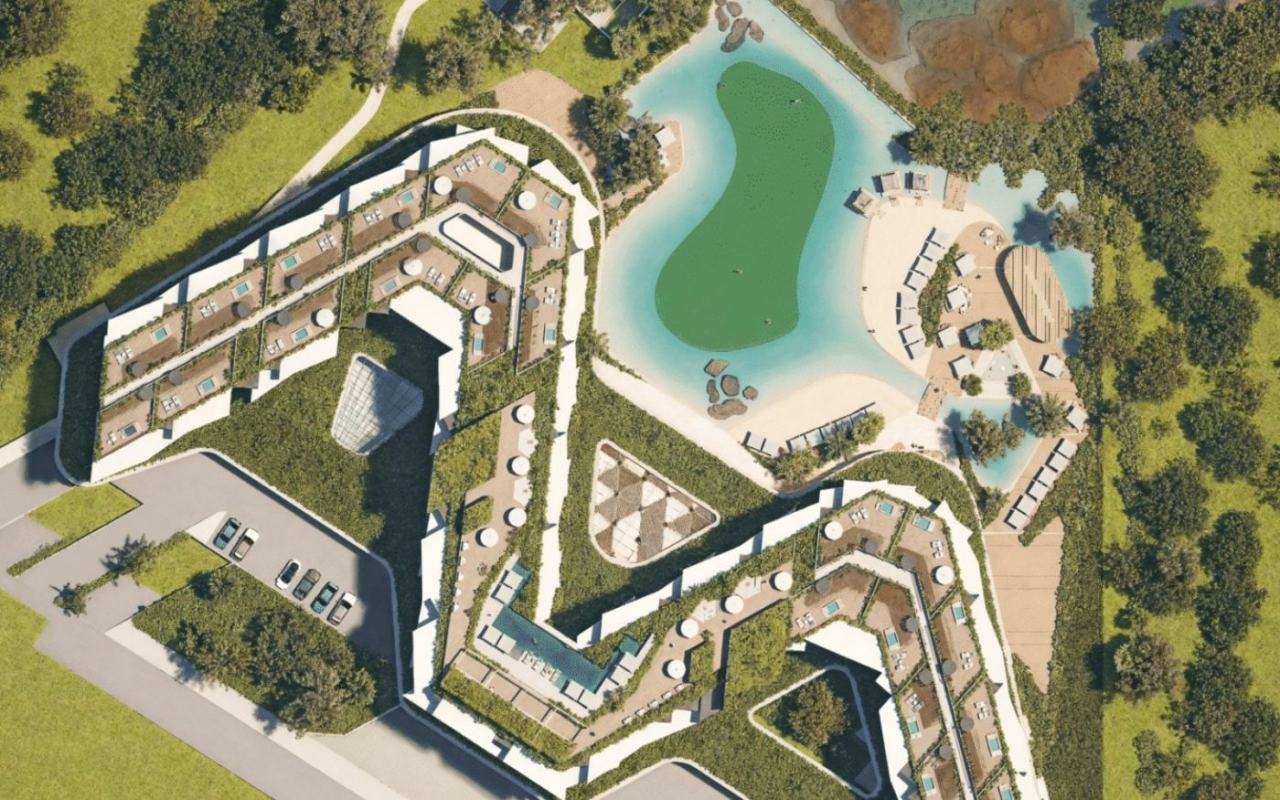
That share does two jobs at once and buyers usually hear about only the first. It is the proportion in which you contribute to keeping the common things in repair — the statute's own bargain with every owner is free use of what is shared in exchange for a proportional contribution to its upkeep. It is also the weight of your vote. At Makai the shared half is the walk-in sand pool and its swim-up bar, the rooftop infinity pool, the spa, the fitness centre, the private cinema, the co-working space, the padel and pickleball courts and the private lake dock — four pools among them. You own a fraction of all of it, and you carry the same fraction of what it costs to run, for as long as you hold the home.
One registered document, four lines that decide everything
A Dominican building cannot slip into the condominium regime quietly. The statute requires a regulation to be registered at the same moment the property is divided, and it requires that regulation to settle four things in writing: which parts are exclusively owned and what each of them is called, how many votes each owner casts in the assembly, the percentage in which each owner contributes to the common charges, and the basis on which the administrator is remunerated.
Those four lines are the constitution of the community you are joining, and they are normally settled before a buyer has heard the word. Ask for the regulation — or for the draft of it, if the building is not finished — and read the four lines in that order. Every argument owners ever have, about a budget, a house rule, or who pays to repair something no deed covers, is decided by the machinery those lines set up.
| What the regulation has to state | Why a buyer should read that line |
|---|---|
| The exclusively owned parts, each with its designation | It draws the boundary of what is yours alone — and therefore what is not, which is everything else in the photographs |
| The votes each owner casts in the assembly | It is your weight in every future decision, and it is written before you arrive rather than negotiated after |
| The percentage each owner contributes to the common charges | It sets your share of running a shared half that, in a resort building, is most of the property |
| The basis on which the administrator is remunerated | It tells you how the day-to-day running of the shared half is paid for, in the document that binds rather than in a brochure |
What you may do with the home is a building-level question
For a buyer looking at condos as an income asset, the question that matters most is the one least likely to be in the brochure. Dominican national law does not forbid letting a home to short-stay guests. What settles it for any particular home is the registered rules of the building that home sits in, which may permit it, condition it, or refuse it outright. A national registration scheme for short-stay hosts has been publicly consulted on and was still not in force when this page was written, so it changes nothing about that answer today.
So the useful question is never "is this allowed in the Dominican Republic". It is "what does this building's regulation say, and who is able to change it". Ask both while you are still choosing, not afterwards. At Makai the answer is bound up with the fact that the whole property is run as a single hotel operation under Dolce Hotels & Resorts by Wyndham — which is the distinction worth drawing next.
Two layers of rules over one building, and they answer different questions
In a hotel-operated condominium two sets of rules sit over one building, and they are constantly confused for each other. The first is statutory and it belongs to the owners: the consortium of owners, which the condominium law requires a registered building to have, which holds legal personality of its own, and in which votes are cast in proportion to each owner's share — a proportion that can be altered only by the unanimous agreement of everyone. The second is commercial: the arrangement under which Makai is operated as one property by Dolce Hotels & Resorts by Wyndham.
The distinction is practical rather than academic. A question about the roof, the annual budget, the reserve, or a rule that will bind all 216 homes belongs to the first layer. A question about how a home is let, what the operator does and what reaches an owner belongs to the second. When something is presented to you simply as "the rules", ask which of the two documents it lives in — because the two are changed by different people, by different majorities, on different timescales.
Why buying before it is built reverses the order of the questions
This market sells mostly what is not finished, and that inverts the sequence a buyer would follow anywhere else. On a resale you can read the regulation as registered, look at the assembly's minutes and the accounts, and walk the building. Off-plan, none of that exists on the day you sign: the regulation is a draft, the assembly has no members yet, and the accounts are a projection of a building nobody has lived in.
Makai hands over in two phases, in Q2 2028 and Q2 2029, and 90 of the 216 residences were still for sale, from $329,000, as this page was written. What follows from that is simply an order of operations. The documents are what to ask for early, while they are still being drafted and while "who decides this later" can still be answered plainly. We will tell you what is already settled, what is still a draft, and which of the two layers above any particular rule will end up sitting in. That costs a seller nothing to answer, and it is the part that is hardest to change once the keys have been handed over.
Common questions
- What does a condo purchase in Punta Cana actually convey?
- Two things, inseparably: exclusive ownership of your own unit, and co-ownership of everything in the development that is not a unit. The second is held as an undivided share, it travels with the home when you sell, and it is the proportion in which you both contribute to the upkeep of the shared parts and vote on them. At Makai Residences the shared parts include four pools, the spa, the fitness centre, the private cinema, the courts and the lake dock, held between 216 homes.
- Who decides whether I can let my condo to short-stay guests?
- The building does, through its registered regulation — national law does not prohibit short-stay letting, so the binding answer is the one written into the rules of the specific development. A national registration scheme for hosts has been consulted on publicly but was not in force when this page was written. At Makai the picture also includes the operating arrangement, because the property is run as one hotel operation under Dolce Hotels & Resorts by Wyndham, so it is worth asking which of the two documents any given rule sits in.
- What is the consortium of owners, and do I have to join it?
- You join it by buying. The Dominican condominium statute requires a registered building to have a consortium of its owners to administer the property and the common things, and it holds legal personality of its own. Votes inside it are proportional to each owner's share rather than one per door, and that allocation can be changed only if every owner agrees. It is worth reading your share before you buy, because it is far easier to check than to renegotiate.
- Can I read the condominium regulation before the building exists?
- Not as registered, because it is registered with the division of the finished property — but you can ask for the draft, and that is the right thing to ask for. Makai hands over in Q2 2028 and Q2 2029, so anything shown today is by definition a draft. Read the four lines the statute requires it to settle: the exclusive parts, the votes, the contribution percentage and how the administrator is remunerated.
Want the details for your own situation?
Ask about availability, layouts or the buying process, and someone from the sales team will get back to you.
Get in touch