Punta Cana Real Estate: Six Words Worth Pinning Down
Search Punta Cana real estate and the results look comparable: similar photographs, similar phrases, prices that line up neatly in a column. They usually are not comparable, and the reason is rarely the prices. It is that six ordinary words — square feet, furnished, beachfront, tax-exempt, projected return and delivery — are used loosely, and each of them can move a figure a long way without anyone writing anything untrue. This page defines all six, and shows each definition against the numbers we publish for Makai Residences, so you can see what a precise answer looks like before you ask anyone else for one.
Why two listings that look alike can still describe different things
Punta Cana names a stretch of the Dominican Republic's east coast rather than a single address, and what is advertised under it runs from finished homes to buildings that are still drawings. Put four of them on one screen and the eye treats them as one set. They are rarely one set.
What breaks the comparison is vocabulary rather than arithmetic. Nothing obliges one seller here to use square feet, furnished or beachfront the way the seller beside them does, and a reader who assumes a shared meaning ends up comparing two different measurements and calling the difference a price gap.
The six definitions below are written as questions a buyer can ask out loud. We publish them from inside one development — Makai Residences, 216 residences in Cap Cana — and answer each one with our own figures, because a definition demonstrated on a real set of numbers is easier to reuse than one stated in the abstract. Nothing here ranks anyone else's project; the point is the vocabulary, not a league table.
“Square feet”: always ask which area the number measures
The commonest mismatch in this market is that a size can be quoted on more than one basis. Interior area counts the enclosed rooms. Constructed area counts the interior plus the residence's own terrace. The home is identical under both readings; the number is not, and outdoor space is a large part of what you buy in this climate.
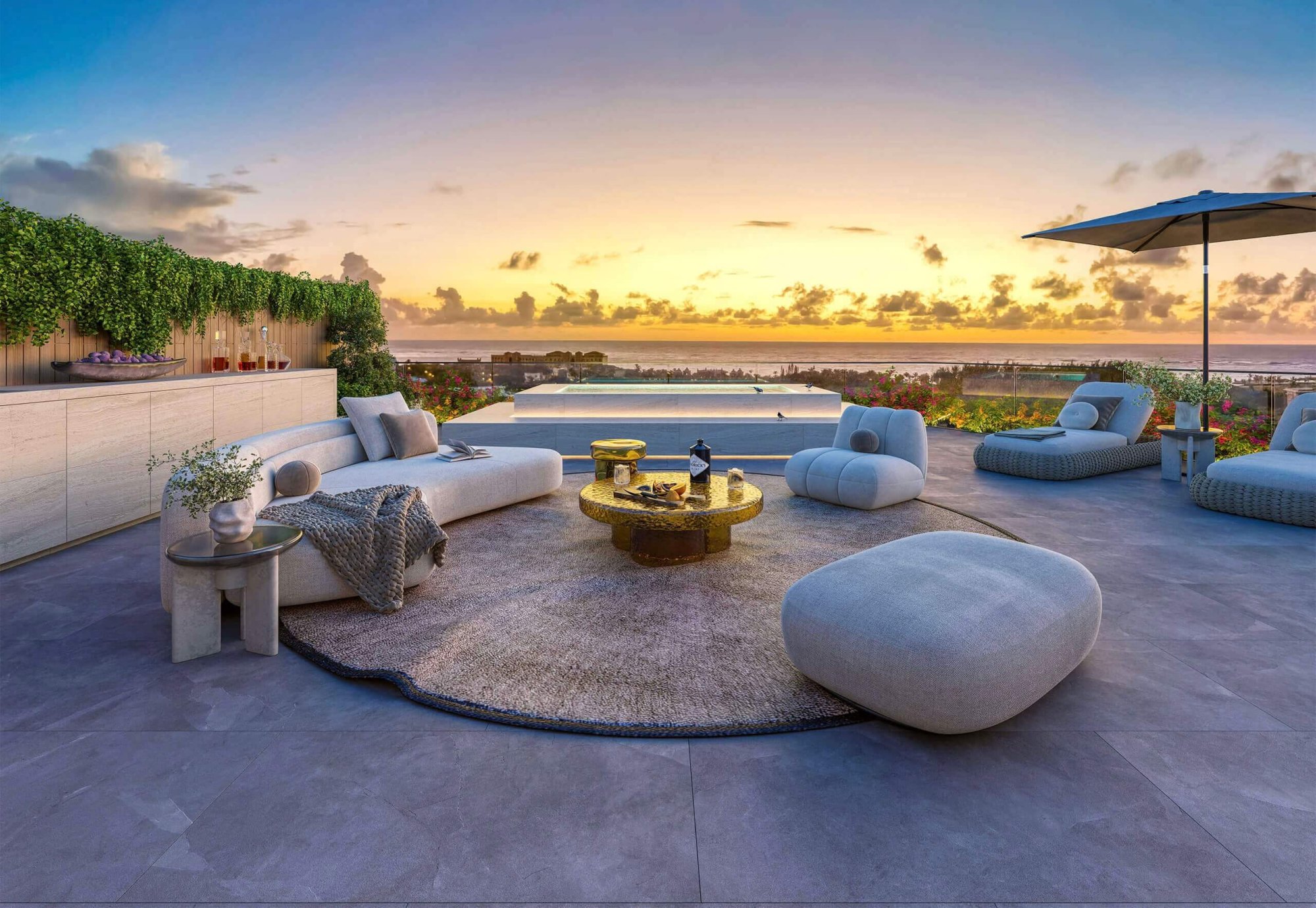
Makai publishes constructed area and says so in as many words: 759 sq ft to 1,489 sq ft, across 17 layouts. A top-floor residence then adds a private roof terrace of 1,034 sq ft, taking its total constructed area to 2,523 sq ft. Describe that same home on interior area alone and it reads as a distinctly smaller property.
So the useful question is not “how big is it” but “which area is that figure”. Two listings can only be set side by side once both have answered it, and the answer costs a seller nothing to give.
| Basis | What it counts | At Makai Residences |
|---|---|---|
| Interior area | The enclosed rooms only, with terraces left out | Not the basis we publish |
| Constructed area | Interior plus the residence's own terrace | 759 sq ft to 1,489 sq ft, across 17 layouts |
| Constructed area with a roof terrace | The above plus a private rooftop, where the layout has one | 1,034 sq ft of roof terrace, 2,523 sq ft in total |
“Furnished”: the word that can hold the whole gap between two prices
“Furnished” stretches from a photograph of staging that leaves with the seller to a package written into the contract and delivered with the keys. Between those two readings sits a real sum of money and several months of somebody's time, and both listings get to use the same word.
At Makai every residence is handed over fully furnished — furniture, kitchen, fixtures and soft goods — because the building is operated as a single hotel-managed rental operation by Dolce Hotels & Resorts by Wyndham, and an operator cannot run one building as one product out of a hundred different interiors. On our page the word is a specification rather than an adjective.
For any listing, the question is what the quoted price actually delivers on handover day, and whether that answer appears in the contract or only in the photographs. A price that includes the interior and a price that does not are not the same number, however alike they look in a search result.
“Beachfront” and “private beach”: what Dominican law lets anyone sell
Along this whole coastline the shore itself is public. Ley 305 of 1968 puts the maritime zone — roughly the first 200 ft inland from the high-tide line — outside private ownership altogether: it cannot be sold, and it cannot lawfully be turned into anybody's private beach.
Public ownership is not the same thing as practical access, and that is exactly where listings get loose. The land behind that strip can be privately held, so a community or a hotel may control the walkway, the parking and the sun loungers while the sand in front of them stays public. Read “private beach” as a statement about access and management, then, and never as one about title.
We describe our own position as a distance rather than an adjective: Playa Caracol is about a 1,600 ft walk from the door at Makai. A distance can be checked on a map before anyone gets on a plane; an adjective cannot.
“Tax-exempt”: name the tax
A Punta Cana listing that says tax-exempt almost always means a project registered under CONFOTUR, the Dominican tourism-incentive law — Law 158-01 of 2001, amended by Law 195-13 of 2013. What the statute names is specific: the 3% property-transfer tax paid at purchase, and the annual property tax known as the IPI, at 1%, which the law sets out as a fifteen-year exemption running from the completion of construction.
Two things follow that a listing rarely spells out. The exemption does not attach by itself — it has to be applied for and recorded against the title — and the law directs it at first buyers acquiring from the developer, so a resale does not carry it forward automatically.
Rental earnings sit under the ordinary tax rules and are assessed on their own footing. Two figures matter there: an 18% ITBIS on short-term tourist accommodation, for which the host carries the liability rather than the platform a booking arrived through, and a 27% withholding on gross rental income paid to a non-resident, taken with no deductions. Rates move, and none of this is advice — treat it as the shape of the question and have a Dominican attorney confirm your own position.
“Projected return” and “delivery”: two words about the future
A projected return is an output of assumptions rather than a measurement, and the assumptions are where the whole argument lives. Makai publishes 7-11% a year. That figure is the developer's proforma, modelled at 60% to 85% occupancy, with the building run as one operation under Dolce Hotels & Resorts by Wyndham instead of as a set of independent lettings. They are projections, not guarantees.
Read any projected figure by asking three things: what occupancy it assumes, which costs come out before the number is shown, and who is responsible for the operation that has to produce it. A return quoted without those three is a number with no method behind it.
“Delivery” is the same kind of word. Makai hands over in two phases, Q2 2028 and Q2 2029. A date on a pre-construction listing is a commitment about the future rather than a description of something standing today, and it is worth reading next to what the developer has already finished.
The six questions, and our own answers to them
Put together, the definitions turn into six questions, all of them cheap to ask and awkward to dodge:
- Which area does that square-foot figure measure — interior, or interior plus terrace?
- What exactly is delivered as part of “furnished”, and is it in the contract?
- Is that beach claim about title, or about access and management?
- Which taxes does the exemption name, who files it, and does it survive a resale?
- What occupancy and which costs sit behind the projected return, and who operates?
- What is the delivery date, and what has this developer already completed?
Our own answers, for the development this page is published on: Makai Residences is 216 residences in Cap Cana, Punta Cana, from $329,000, delivered fully furnished, with four pools and water features on site, Playa Caracol about a 1,600 ft walk away and Punta Cana International Airport about 15 minutes by car. Sizes are constructed area, 759 sq ft to 1,489 sq ft. Phase 1 hands over in Q2 2028 and Phase 2 in Q2 2029. Ask anyone else the same six questions and write the answers down; the listings that can answer them are the only ones you can honestly compare.
Common questions
- Why do two Punta Cana listings quote different square footage for similar homes?
- Usually because they are measuring different things. Interior area counts the enclosed rooms; constructed area adds the residence's own terrace. Ask which basis a figure uses before comparing it with anything else. Makai publishes constructed area — 759 sq ft to 1,489 sq ft across 17 layouts — and a top-floor residence adds 1,034 sq ft of roof terrace on top of that, for 2,523 sq ft in total.
- Does Punta Cana real estate come furnished?
- Sometimes, and the word covers both a staged photograph and a contracted delivery. At Makai every residence is handed over fully furnished — furniture, kitchen, fixtures and soft goods — because the whole building runs as one hotel-managed rental operation under Dolce Hotels & Resorts by Wyndham. Whatever the listing, ask what the contract says arrives on handover day.
- Can a foreign buyer own property in Punta Cana outright?
- Yes. A foreign buyer takes registered title in their own name, on the same terms as a Dominican national, with no residency requirement and no local partner needed; the old requirement to obtain presidential approval was abolished by decree in 1998. Title is recorded under the real-estate registry law, Ley 108-05, and the conveyancing itself is a matter for your own Dominican attorney.
- What does CONFOTUR mean on a Punta Cana listing?
- That the project is registered under Law 158-01 of 2001, as amended by Law 195-13 of 2013. The statute names the 3% property-transfer tax at purchase and the annual IPI at 1%, set out as a fifteen-year exemption running from the completion of construction. It has to be applied for and recorded against the title, and it is directed at first buyers acquiring from the developer, so a resale does not carry it forward automatically. Rental earnings are assessed separately, and your attorney should confirm how that applies to you.
- Is a projected return the same as a rental yield?
- No. A yield is measured after the fact; a projection is a model, and it is worth exactly what its assumptions are worth. Makai's published 7-11% comes from the developer's proforma at 60% to 85% occupancy, with the building operated as a single rental operation. They are projections, not guarantees, and the assumptions behind any projected figure are the thing to ask for.
Want the details for your own situation?
Ask about availability, layouts or the buying process, and someone from the sales team will get back to you.
Get in touch